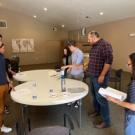
At UC Davis, graduating seniors in materials science and engineering spend their final year solving real problems for professional sponsors, emerging with the hands-on skills, mentorship and workplace-ready experience that traditional coursework rarely provides.
Tanaya Sahoo, a second-year international graduate student in the materials science and engineering master's program, aims to deploy advanced, sustainable technologies to solve real-world problems.
Two Ph.D. candidates in materials science and engineering at UC Davis will reside at Lawrence Berkeley National Laboratory to conduct research as part of the U.S. Department of Energy Office of Science Graduate Student Research Program.
Assistant Professor of Materials Science and Engineering Scott McCormack is part of a multi-university team awarded $7.5 million over five years from the Department of Defense Multidisciplinary University Research Initiative, or MURI, program.
Through teaching, mentorship and outreach, the assistant professor champions accessible materials science education, emphasizing real-world connections and hands-on experiments to inspire future scientists.
New research published in Physical Review Letters shows how an experiment with lasers and magnets resulted in the domain walls within ferromagnetic layers moving at previously unheard-of speeds, paving the way for more sustainable and energy-efficient data storage.
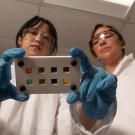
Materials science and engineering professor Marina Leite has received $1 million to make switchable photonic devices more efficient with hybrid perovskites, a class of materials with physical properties that can be controlled through light alone.
Marina Leite is on her fourth cell phone. A professor in the Department of Materials Science and Engineering at the University of California, Davis, and a Chancellor’s Fellow, Leite is holding out on upgrading her phone because tossing her old one would produce excess waste.
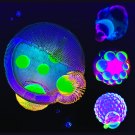
The inside of a living cell is crowded with large, complex molecules. New research on how these molecules could spontaneously organize themselves could further our understanding of how cells manage their essential biochemistry in the crowded space.
We all have experience with water turning from solid to liquid to gas and back again.
But knowing what happens scientifically during those transitions is an essential, yet unanswered scientific question that Assistant Professor of Materials Science and Engineering Jeremy Mason and his research group are pursuing.